
Fall 2026 - Signal Issue - The Harvard Advocate
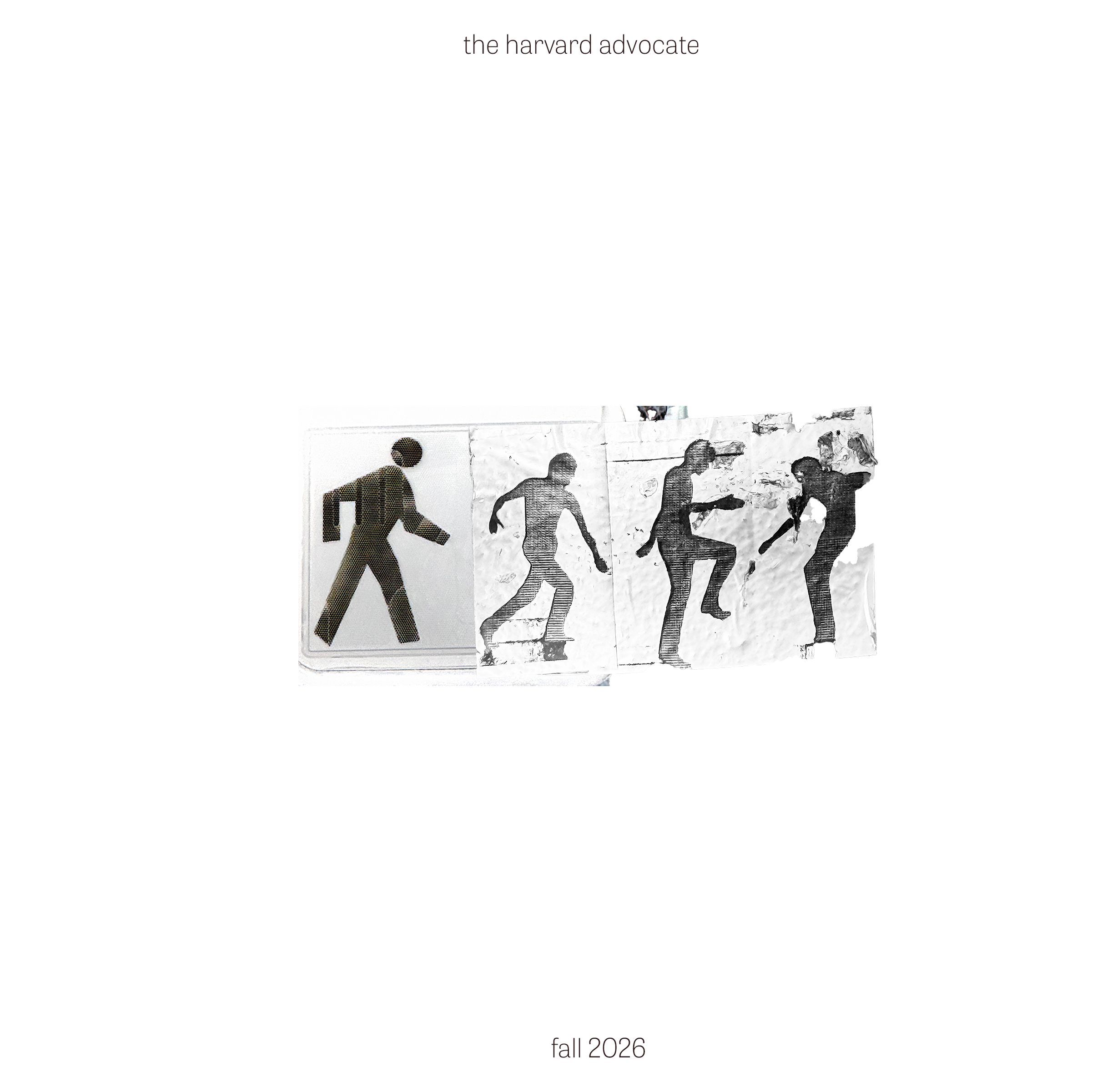
TRUE / FALSE
The trouble with the truth is that everyone has one.
Memory is an unreliable witness, and every narrator has something to hide. Yet nothing reveals quite as much as a disguise. The truth is rarely pure and never simple.
The inside is out; the outside is in. And this is certainly not a pipe.
The more the self is externalized the less certain we become of its substance.
Are we revealing, or constructing?
Do you know it when you see it, or see it when you know it?
Nothing is, but what is not?
This issue, the Advocate welcomes all that is TRUE and FALSE.
We ask what can be known, what can be shown, what remains beyond the frame, in the margins, between the lines. The question is not simply which is true, but whether the difference matters.
From the counterfeit to the confessional we consider what happens when the real and unreal trade places. After all, the truth, like any good story, depends on its telling alone.
TRUE/FALSE does not seek to close the rift. It demands that we sit in multiplicity and simultaneity.
This issue asks not for answers but entanglements. Linger in contradiction. Fracture the binaries.
Give us your staged confession, your unreliable narrator, your digital double, your performative utterance. Contradict yourself, contain multitudes.
Graveyard
What we call the beginning is often the end.
— TSE
Do I contradict myself? Very well then I contradict myself, I am large, I contain multitudes.
— WW
Truth is stranger than fiction, but it is because Fiction is obliged to stick to possibilities; Truth isn't.
— Twain
To be seen is to be verified. To have your own existence confirmed back to you.
But what is left behind, within? Remains unsaid, unsayable?
The Advocate asks: when anything can be fabricated, what still counts as true?
Features • Fall 2026 - Signal
Majdanek, the former extermination camp outside the Polish city of Lublin, is black, though none of its parts are. The long barracks, the few which still stand after a fire in 2010, are really a deep brown, wrought of a wood so dark it threatens to devour all the light around it. So too are the pyramidal guard towers, lining the main road of the camp, like gloomy, fuliginous sentries. At the end of the long road, or perhaps at the beginning, is the mausoleum: an enormous green dome, evoking a flying saucer, as though such a thing could come about only from the arrival of some mysterious and murderous extraterrestrial civilization. Emblazoned on its side in stark concrete lettering, in Polish:
Features • Fall 2026 - Signal
On the western seaboard of the East Coast, a multimillionaire’s investment in one of Maryland’s “most charming small towns” has caused quite the splash. Described, once, by Frederick Douglass as “remarkable for nothing that I know of more than for the worn-out, sandy, desert-like appearance of its soil” and the “indigent and spiritless character of its inhabitants,” Easton, Maryland, has had a much needed facelift, under Paul Prager’s scalpel.
Features • Fall 2026 - Signal
I hold in my hand something green that didn’t exist before men made the atomic bomb. It’s an alien rock of sorts, not fully of this world. Mystic and destructive as its birth was, this stone was still created from the first blast. Trinitite: at one point, the government put it behind bars. At one point, anyone could grab a piece. This anthropogenic technofossil is the oldest atomic mutation, a vestige of the holy trinity, a token of the first nuclear bomb.
Features • Fall 2026 - Signal
Living in New Bedford, Moby Dick appears on street corners and harbors like a handprint of ink stamping and stamping, getting fainter as it grabs hold of every new building, restaurant, and hotel. Growing up, Moby Dick is the fancy restaurant only business owners and city implants go to. Herman Melville, as in Melville Towers, are apartments looming over a fishhouse that you can smell from the freeway. Melville, I feel we never got a chance to understand each other; you speak to our city in street signs, a call without direction.
Features • Fall 2026 - Signal
I was not going to wait in that queue for the toilet. It extended from the door to the DJ, a procession of people snaking out, each waiting to relieve themselves in one way or another. No, I was not going to wait in that queue. The pills, by this point, were making my vision feel choppy; I could blink and people would appear in completely different places than where they’d been moments before. It was an amusing game, making people shift and disappear. But when I opened my eyes, there was also this disturbing sensation. Faceless dancers flickered in the corners of my vision—apparitions I could immediately vanquish by simply directing my gaze towards them.
Features • Fall 2026 - Signal
I was fourteen when I first met Humbert Humbert. It was a humid July, the kind of summer where the air feels heavy enough to bruise and the heat rays ripple off the stone of the garden steps. I was restless, passing the days lying on my stomach reading, alternating between the stiflingly wet heat of the garden and the over-air-conditioned living room. The nights I’d pass in the room I shared with my sister, reading in dim light after she’d fallen asleep, listening to the swelling, electric thrum of cicadas outside.
Poetry • Fall 2026 - Signal
sojubottle vase, dead
Poetry • Fall 2026 - Signal
Put the horizon back on its hinges.
Provoke a fiddler crab into a porcelain-clawed
war for control of the moon. Light inches
toward lighter fluid. Resist the urge to prod
the miles of cattle fence that grow tiny red hands.
Don’t pattern the salt flats with tire tracks.
You aren’t in a position to make demands
of the desert. Look: a blue-lidded man reacts
to his own fossil walking out of his life.
Don’t look: stingrays swimming up and down
the flooded highway. A lizard midwife
with no source tale is waiting to drown
you. Cut your breaks. When you run out of air,
the desert will drive you almost anywhere.
Poetry • Fall 2026 - Signal
With this body all under such sun. With this
sun as swollen as a body, I watched them
Poetry • Fall 2026 - Signal
Nella toilette al piano interrato,
dove sto urinando, c’è
una mosca sul pavimento.
Ubriaca, incattivita, affamata di luce e
affamata e basta.
Potrebbe uscire
non trova la strada
non sa che deve passare l’antibagno
risalire le scale
girare l’angolo
dirigersi verso la porta automatica
o forse lo sa
e non ha voglia, o forze, per farlo.
Esco
mi lavo le mani
mi guardo le spalle e lo sterno
così sottili nell’estate che mi macina
e che non sa che io sto macinando lei.
Potrei portarla fuori, quella mosca.
Ma non lo farò.
Poetry • Fall 2026 - Signal
the fact of the broom is not the brush component
where it goes to swoosh mother proud
gotta move it with pressure
to beat crud out of cracks of shitholes
Notes from 21 South Street • Fall 2026 - Signal
Trying to amuse myself while home for the summer, I decided to take a few shifts as a substitute teacher. I’ve never been passionate about education, but it seemed as good a way to kill time as any. By the hand of some cruel substitute-teacher-sorting god, I was placed in middle school. I consoled myself: it would be less sentimental than elementary or high school would have been (after public elementary, I attended, for some reason, a private middle school. I then returned to the public high school after I was rejected from Andover), so at least I wouldn’t be crying on the clock. Yes, even though middle school is notoriously one of the worst things ever, I would approach the situation with a cool air of indifference. I would have rather not gone back to the old house. At least not my old house. This was someone else’s old house with someone else’s skeletons in the janitor’s closet. I got to walk through those foreign hallowed halls for the first time, my temporary badge pasted precariously to my shirt. Yes, it read ‘VISITOR.’ I was given what is, in one’s hometown, the rare blessing of novelty.
Notes from 21 South Street • Fall 2026 - Signal
MORE OF:
Fat City by Leonard Gardner (1969), novel
Basically there are three guys that have been into boxing for varying amounts of time and are in different stages of their relationships to boxing and it’s all quite sad and bleak but a moving portrait of the lives of these three men and the people who surround them in Stockton, California. — Bradford Danby Kimball
Fiction • Fall 2026 - Signal
Take a load off—we’re gonna be awhile.
The party is over, fish been fried, Barbie been cued. All there’s left is to leave. What a man—what a man, what a mighty good man etc., and spill onto the steps of The Good First Baptist, where the staircase slopes down and will lead us into the parking lot. Yet as soon as the doors swing open, suddenly the breeze is gathering around black bodycon dresses, pantsuits and pillbox hats, strappy black heels, lavender button-ups over denim. It stops us short of cars pulled right up on the curb and we recede up the steps in it. The sun is setting now, and its dying pulses of orange and pink match the yogurt Reisha gives to her little dude, Papa Bear, as she sits him atop the bannister, making Pam shake her head like, he’s too spoiled. Spoiled with these newfangled things.
Fiction • Fall 2026 - Signal
BOCA COLORADO
We call it Manuelo’s year.
When we find the Indian boy in a muddy riverside town, he talks with his gaze welded to the floor and his shoulders curled forward like they shelter a small flame between them. He’s spent the whole day at the village’s only bus stop, a roofed bench between three wood walls where employers sometimes pin job notices.
Fiction • Fall 2026 - Signal
"Toad Mountain" is the winner of the 2026 Louis Begley Prize, judged by Andrew Krivák.
Editor's Notes • Fall 2026 - Signal
And the people bowed and prayed,
to the neon god they made
and the sign flashed out its warning
 2026