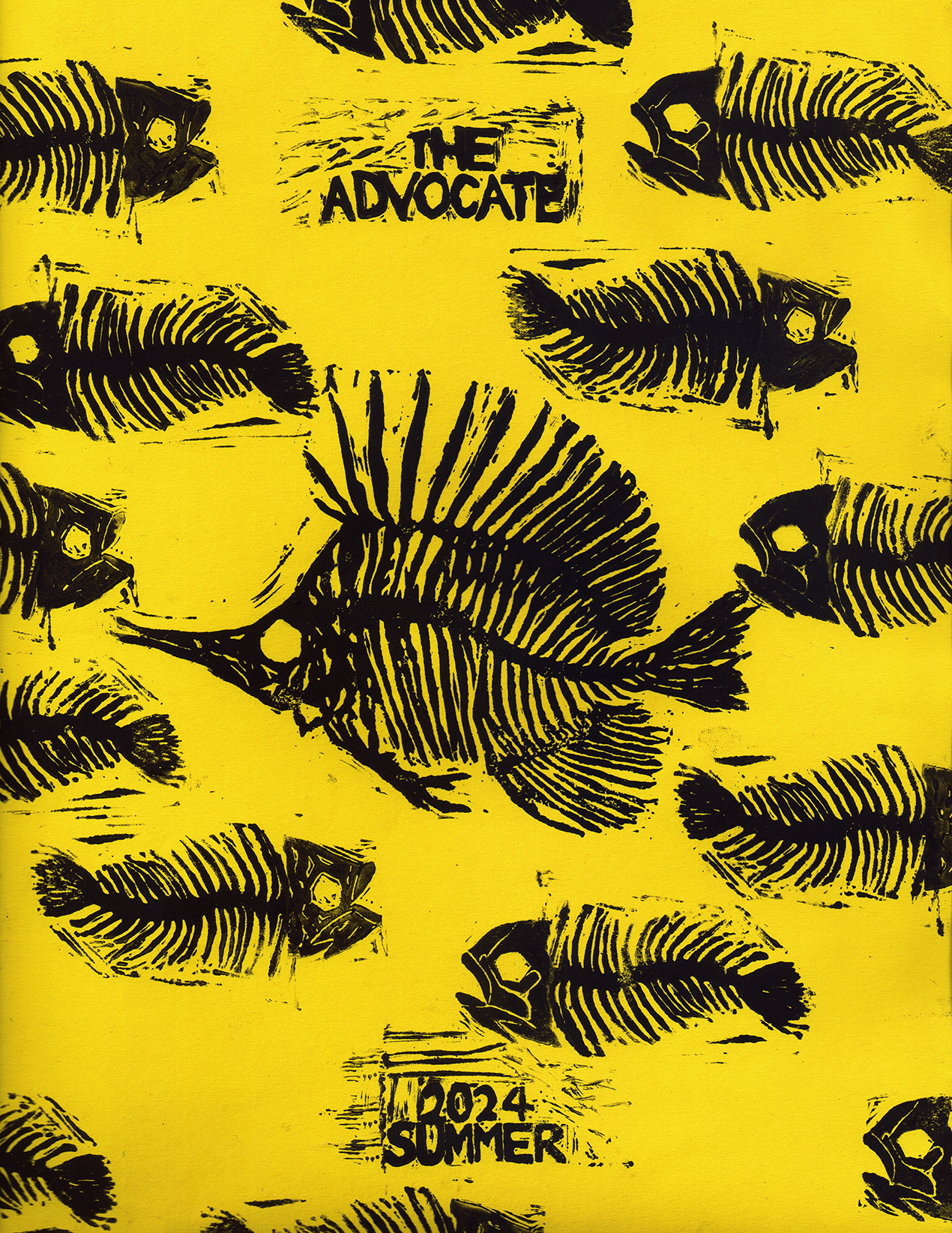
Summer 2024 Issue - The Harvard Advocate
Poetry • Summer 2024
Somehow I cannot stomach the slow killing of a bug
the wasp who’s found its way inside
on the wall to the right of me—I shut my eyes and
Poetry • Summer 2024
It’s not necessary to behead the yolk-haired woman
who dances with children in the streets of Eko
Poetry • Summer 2024
before you started visiting small-scale extinction events on your brain cells
and after ecstasy or against it
Poetry • Summer 2024
For all the geology of seawater, for all
the time in clay, I am grateful
for a new year. “New” because we say
so. Behold Janus’s two faces.
See how she closes one door in order
to open another. A cracked vessel
blessed my face with water you read
as tears. A fire sewed smoke
into my clothes. The firemen hacked
open the door. For a year I smelled of tar,
like the La Brea monster bird who dreamed
the tar pit as a lake, who tasted
rainwater atop ancient pools of crude, then sank.
Except, I quit the house and the broken
door, and I left the man enmeshed
in December, and the firemen
with their hoses, and the water running
like steps down the stairs. Here,
I spill into January. I shatter
the cracked china because its value
is precisely in its uselessness.
I dust the fossil, the headstone,
and the oyster shell. Stars sprawl
across my shoulders as the moon bears
its wearied repetitions. Still,
there are so many firsts to be had.
Poetry • Summer 2024
Leaves of trees were more alive
than the birds, as my mind went
back to the chauffeur kneeling,
waving his wand—the detector
for explosives under the sedan,
saying, “Just in case.” Then after
checking into The International,
I go upstairs to a room, & I ask,
Have I been here before, standing
at this mirror? A shadow of birds
in trees outside the park pulls me
up to the window, & then a voice
saying, “Do not go to the park.”
Those birds tell all of us to look,
& then I feel as if they are woes
disfiguring the sunset, or lovers
of those gone into Kenyan bush.
My face here on a windowpane,
seeing them as part of myself.
They make the trees smaller,
divined by a lifetime of pleads.
A silhouette of them in the trees
moves with me toward the park,
but before I enter a voice says,
“If your driver had not waved
the wand beneath that sedan
maybe you would not be here.
You know, timing is everything.”
I stood again at the window
as if only waiting for someone
to stir up that cloud of wings
waiting for the world to end.
All at once, I wanted to hug
someone, or to just hold her
against me, breathing as one.
Their skullcaps of pale feathers
became too much to believe in.
Such a ragged hour of half-dead
dreams & deep longing. Maybe
if not the park, I’ll go to the bar
on the corner. I stop at the door,
turn, & walk back to the hotel.
A week later, a grenade is tossed.
Three Aussies die in the Jericho,
& I try to say what turned me
around at the door but I can’t.
Their gaze on me, & half-dark
wings writhing into specters
or deep eyes of prophecy.
Features • Summer 2024
Features • Summer 2024
Every summer, my Latgalian grandmother, who I call baba, my mom, and I gather in a church in the Latvian border village of Ņukši. I kneel on my left foot, cross myself, and sit down on the lacquered pew, put there by some Polish monk who came from Vilnius, Kraków, or Vitebsk to spread the faith up north. The cold, half-lit room fills with incense, the gliding vowels of Latgalian, and the intoxicating smell of sweet, piney myrrh. My knees dig painfully into the wood as we are finally released by the priest with one last āmen.
Fiction • Summer 2024
One day when you’re sitting at your desk working on your doctoral thesis in linguistics, your mother calls, and she’s hysterical crying and panting. You can hardly understand her. “I don’t know who I am,” she wails.
Fiction • Summer 2024
1
I was born twenty years ago, in Connecticut, to a healthy father and a sick mother. Because they found the tick late in my mother’s pregnancy, the doctors weren’t sure if I would be born with her disease. They ran dozens of tests, both before and after I was born, with laparoscopes and eight-inch needles. My father remained worried until I was two months old, after an intensive blood panel came back negative. He has always been a pessimist.
Fiction • Summer 2024
"All the Difference" is the 2024 winner of the Louis Begley Prize judged by R. F. Kuang.
 2026